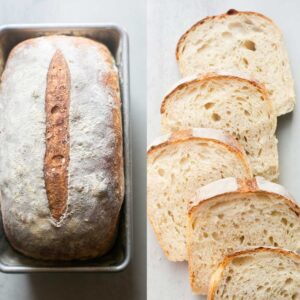
How To Bake Sourdough Bread In A Loaf Pan
Learn how to bake sourdough bread in a loaf pan, including how to shape your dough, how to make a same day loaf or an overnight loaf, and the differences between baking in a Dutch oven verses a loaf pan. This is an easy, beginner friendly sourdough bread recipe baked in a loaf pan!
Equipment
- 1 Large Bowl
- 1 8x4 inch loaf pan
Ingredients
- 350 grams water
- 100 grams active sourdough starter
- 500 grams bread flour
- 12 grams salt
Instructions
Make Dough
- Mix together the water and starter in a large bowl. Add the bread flour and salt and mix until a sticky, loose ball forms. Cover the dough with a damp tea towel or plastic wrap and let the dough rest for 30 minutes.
- With damp hands, stretch and fold the dough by grabbing one side of the dough and stretching it up and over itself. Rotate the dough and repeat, working around the dough in quarter sections, until the dough forms a tight ball. Do 2-4 sets of stretch and folds, spaced 20-30 minutes apart.
Bulk Ferment
- Let the dough rise for 4-6 hours or until almost doubled in size. See notes for tips on when the dough is done bulk fermenting.
Shaping The Dough
- Grease and flour an 8x4 inch pan. Dump the dough out onto a lightly floured surface and form into the loose shape of a square. Pick up the right side of the dough and fold it into the center. Repeat with the left side of the dough. Roll the dough from bottom to top, pulling it towards you several times to create tension in the surface of the dough. The dough will elongate as you pull it towards you. Place the dough in the greased pan and cover.
Cold Ferment
- Place the dough in the fridge to cold proof for at least 30 minutes.
Score + Bake
- When ready to bake, place a cast iron pan with 1.5 cups water on the bottom rack of the oven. Preheat oven to 425 degrees F. Slowly open the oven door and add your dough to the middle rack. Back for 25 minutes, then remove the cast iron pan. Bake for an additional 20-25 minutes or until the crust is golden brown.
- Let the bread cool for 5 minutes in the pan, then transfer to a wire rack and cool for 1 hour.
Notes
- Bulk ferment: Bulk ferment is done when the dough pulls away easily from the side of the bowl, the top of the dough is slightly domed, and there are air bubbles throughout. The dough will feel jiggly.
- Steam: Instead of using a cast iron pan to hold the water, you can use a shallow glass pan. Or, you can top the 8x4 inch pan with another 8x4 inch pan, and remove it halfway through the bake.
- Overnight ferment: Change this recipe to an overnight ferment by reducing the amount of starter to 60 grams and proofing for a longer time period, overnight.
- Temperature: Dough will ferment faster in a warm kitchen and more slowly in a cool kitchen. This recipe was tested at 75 degrees F, making for a fairly quick ferment time.
- Storage: Store bread in a bread box or paper bag for 3-5 days. To freeze, slice and wrap each slice individually in parchment paper, then place in a ziploc bag.
Nutrition
Calories: 181kcalCarbohydrates: 36gProtein: 6gFat: 1gSaturated Fat: 0.1gPolyunsaturated Fat: 0.4gMonounsaturated Fat: 0.1gSodium: 2793mgPotassium: 51mgFiber: 1gSugar: 0.2gVitamin A: 1IUCalcium: 10mgIron: 0.5mg
Tried this recipe?Let us know how it was!
