

Easy Sourdough Sandwich Bread (Soft + Fluffy)

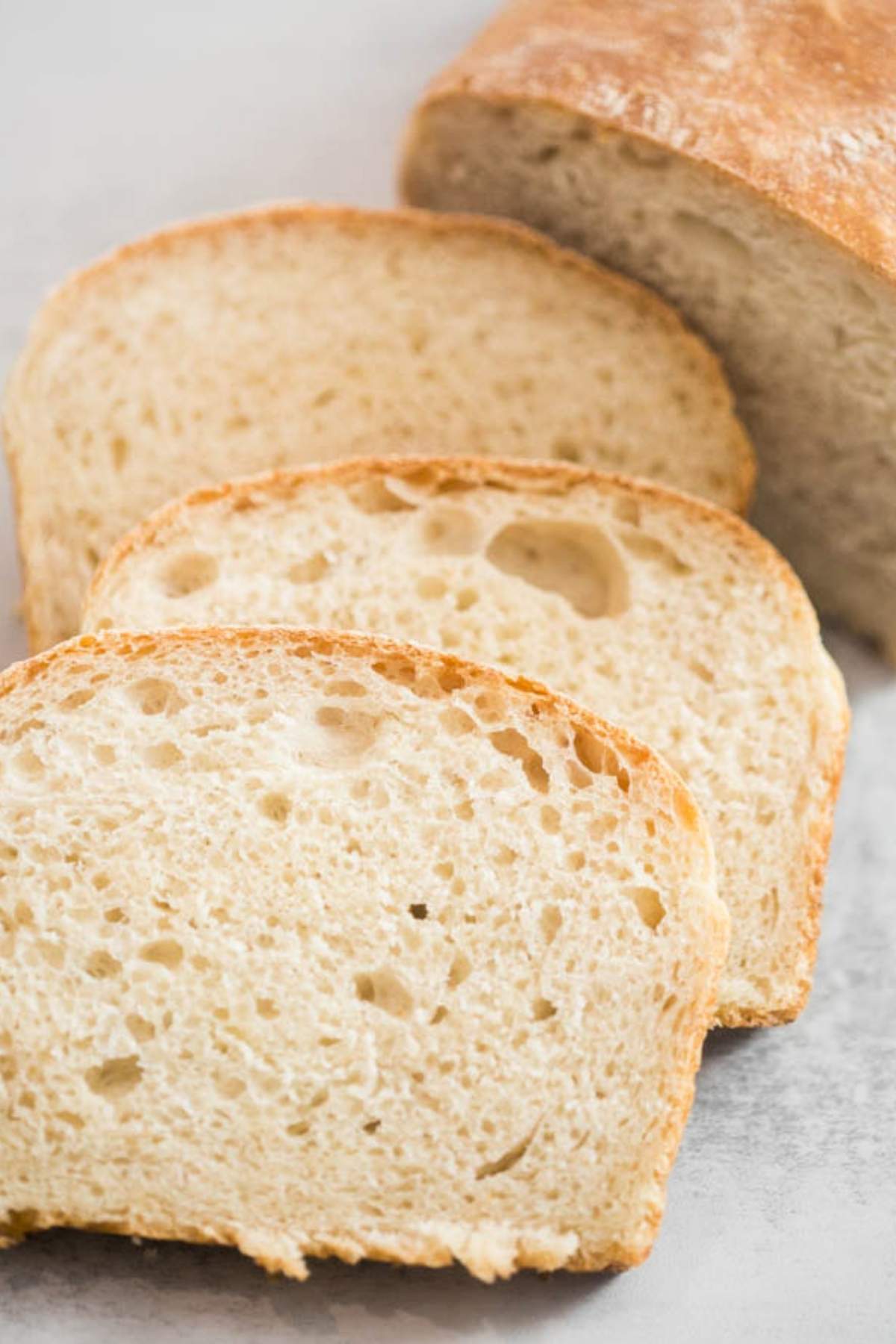
This easy sourdough sandwich bread is not only perfectly soft and fluffy, it’s also easy to make: the perfect homemade bread for any sourdough enthusiast!
This is a no-knead recipe that takes just a few moments to whip up.
Jamie’s Recipe Summary! – Easy Sourdough Sandwich Bread
- Taste: Slightly sweet with a sourdough tang.
- Texture: Soft, fluffy, and light- yet chewy and substantial for sandwiches + toast.
- Total Time: 12 hours, including fermentation.
- Skill level: Easy, beginner friendly.
- Tools needed: 9×5 inch loaf pan, large bowl
- Why is this recipe the best? This soft and fluffy sourdough sandwich bread is easy to make, requires no stretch and folds, and is simple enough for brand-new bakers. It gives a soft and fluffy crumb perfect for sandwiches and toast!
Summarize and Save This Recipe Content On:
Why You’ll Love It
If you are looking for a simple bread recipe that’s perfect for filling with your favorite sandwich toppings, you’ve come to the right place. This recipe has thousands of 5 star reviews on pinterest- it is simply the BEST bread recipe!
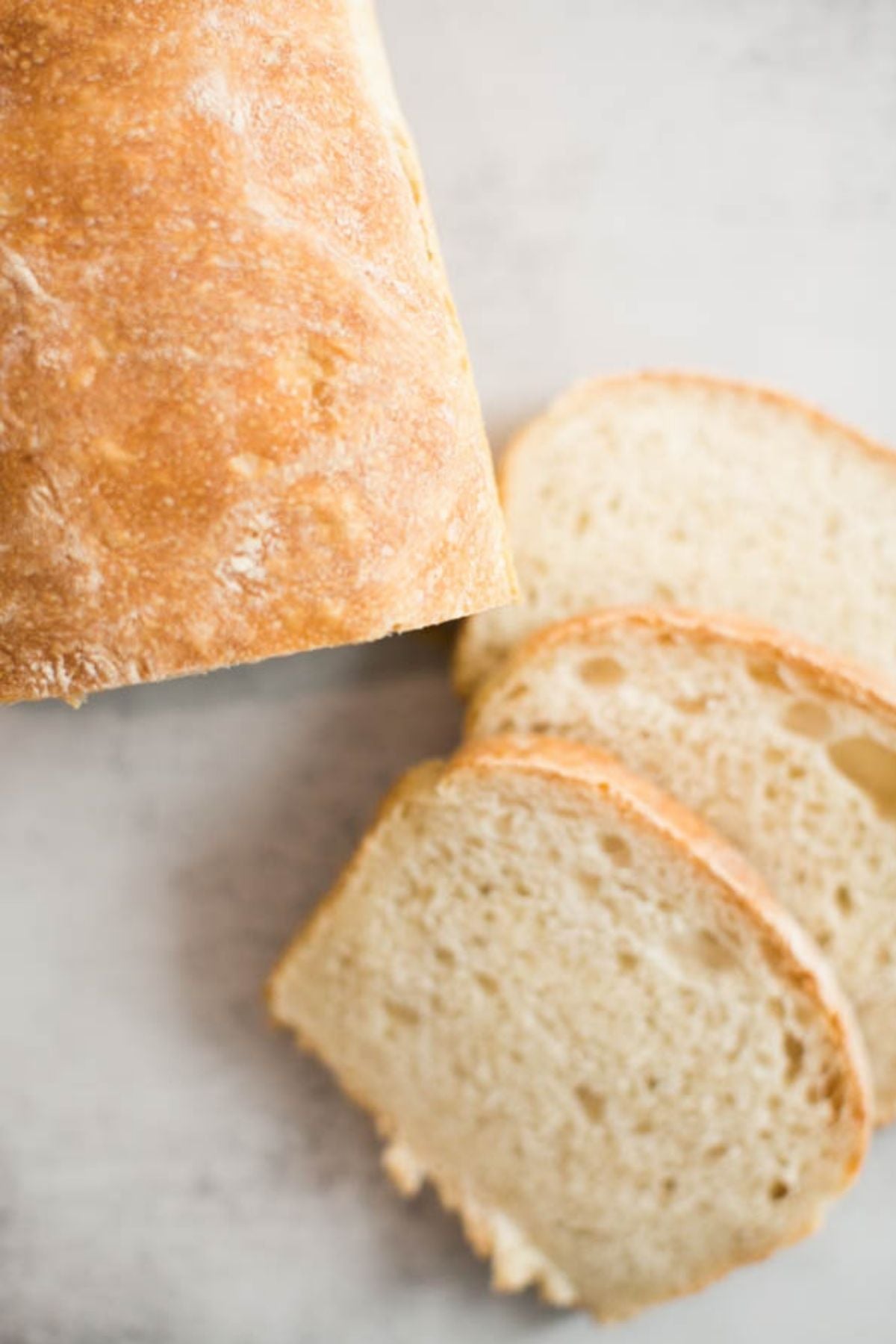
This easy sandwich loaf features a light, airy, flavorful crumb perfect for sandwiches and lovely toasted and slathered with butter.
But what I love most about this homemade sandwich bread is how easy it is to throw together. Mix all the ingredients and let it sit! No kneading, watching the clock, or stretch and folds are required.
Tessa says: “This was my first time making anything with sourdough, and I can’t believe how easy and good this bread is. Thank you! I will be making this a bunch.”
If you are brand-new to sourdough bread baking, you can learn how to make sourdough in a Dutch oven here. This same day sourdough bread and easy sourdough bread are also great for beginner bakers.
Ingredients
Please see recipe card for all ingredients + amounts.
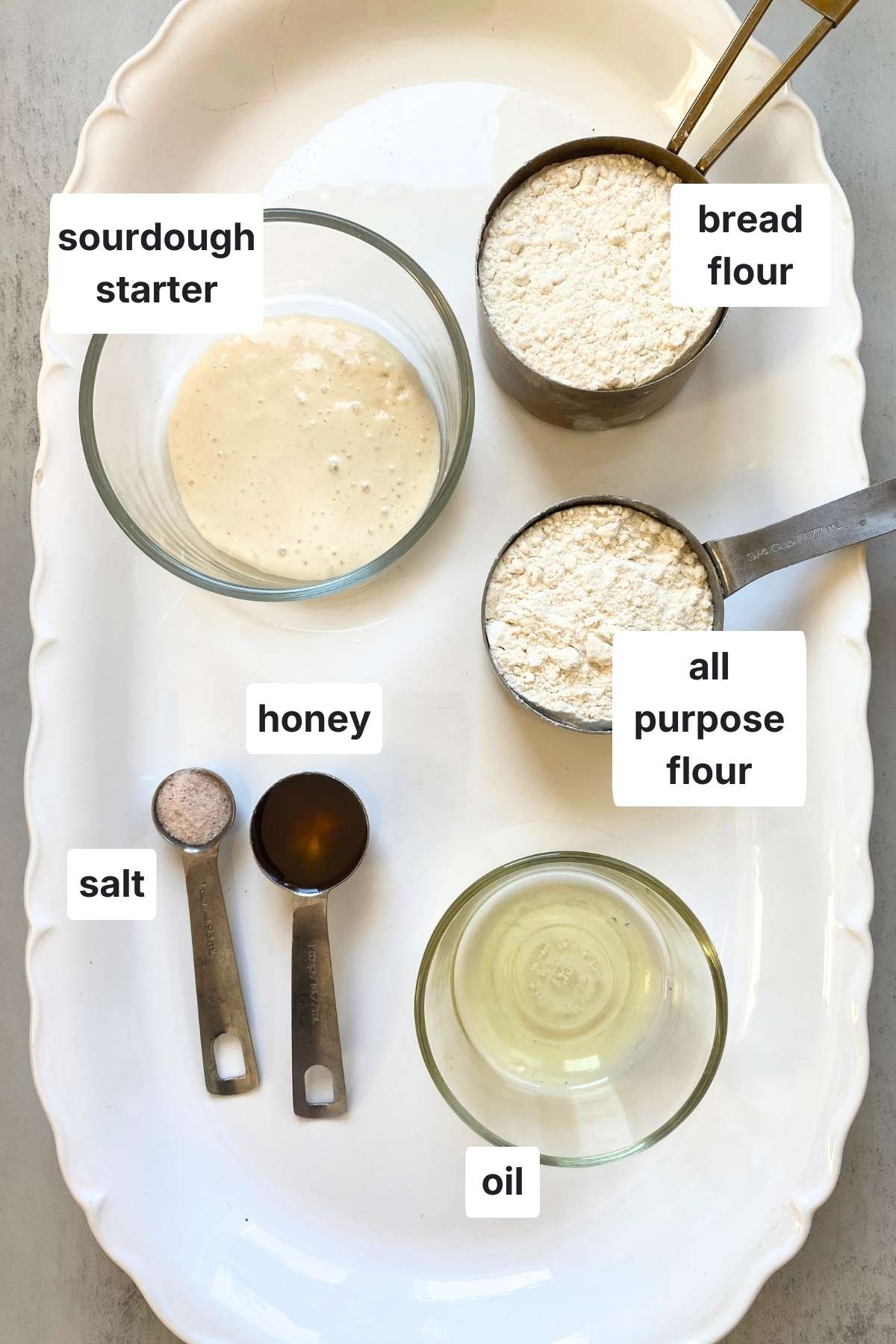
- Active sourdough starter: Use an active, bubbly sourdough starter before making this recipe. Feed it 4-8 hours before making your bread, allowing it to peak in activity before adding it to the dough- use this guide to learn how to feed a sourdough starter.
- Lukewarm water: Water around temperature of 80 degrees F.
- Oil: Oil softens the dough, making this bread extra tender. Avocado oil or olive oil can be used.
- Flour: both bread flour and all purpose flour are used: the bread flour adds more gluten structure and the all purpose flour increases the softness of the bread.
Jamie’s Recipe Tips
- This recipe has been tested at a room temperature between 71-74 degrees F. You can speed up the ferment time by increasing the temperature. Some people like to use a bread proofer, or turn on the oven light and warm the bread within.
- The dough can be placed in the refrigerator after the first rise if you need to pause the process.
- The second rise will take a while: a good 3-6 hours at a temperature of 71-75 degrees F. For soft, fluffy bread with a good rise, make sure the dough rises above the top of the bread pan.
- To speed up the second rise, increase the temperature. Set the dough on top of a warm oven, or use a bread proofer or heating pad.
- Make sure you are using a strong, robust starter for this recipe. If your starter seems weak, you can learn how to strengthen a weak starter here.
- If your bread cracks along the sides when baking, it means the second ferment was not quite long enough.
- For a same-day loaf, increase the sourdough starter to 100 grams and mix the dough early in the morning.
Tips for beginners: I typically feed my sourdough starter at 2 pm, and by the time I make this bread at 9 it is bubbly and active. Timing can change based on the season and how much you water and flour you feed it, however. Check out my easy sourdough bread baking schedules for simple ways to plan your fermentation.
Recipe Variations + Substitutions
- Melted butter may be substituted for the oil.
- Honey may be substituted for sugar.
- A beautiful cinnamon swirl can be added to this sandwich bread-cinnamon sandwich bread variation here.
How To Make Fluffy Sourdough Sandwich Bread
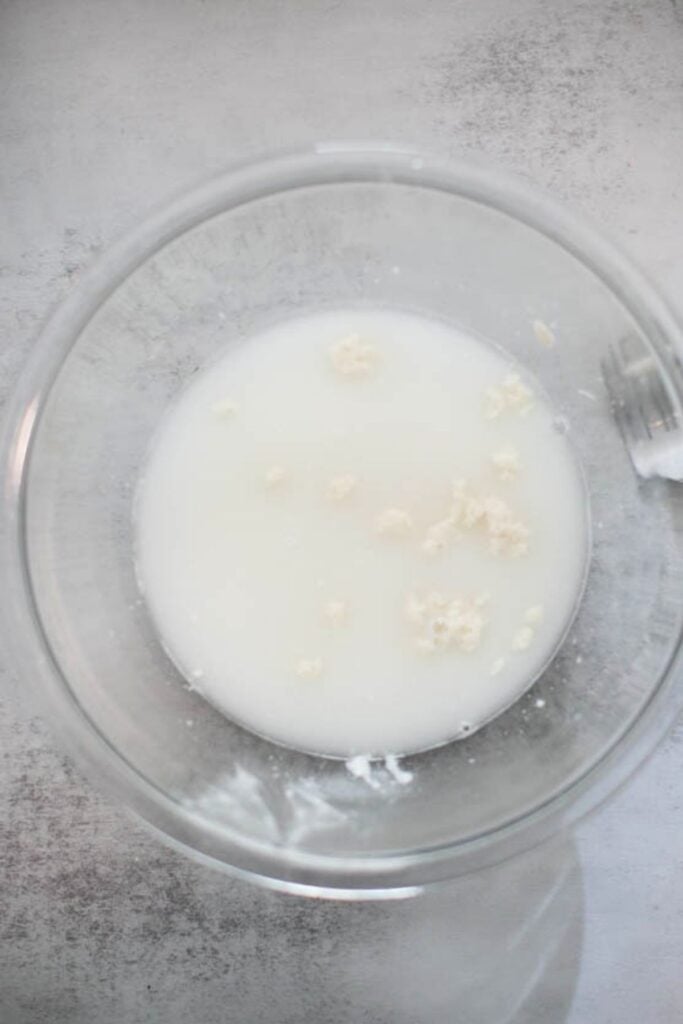
Step 1: Add the water and active sourdough starter to the bowl. Whisk well.
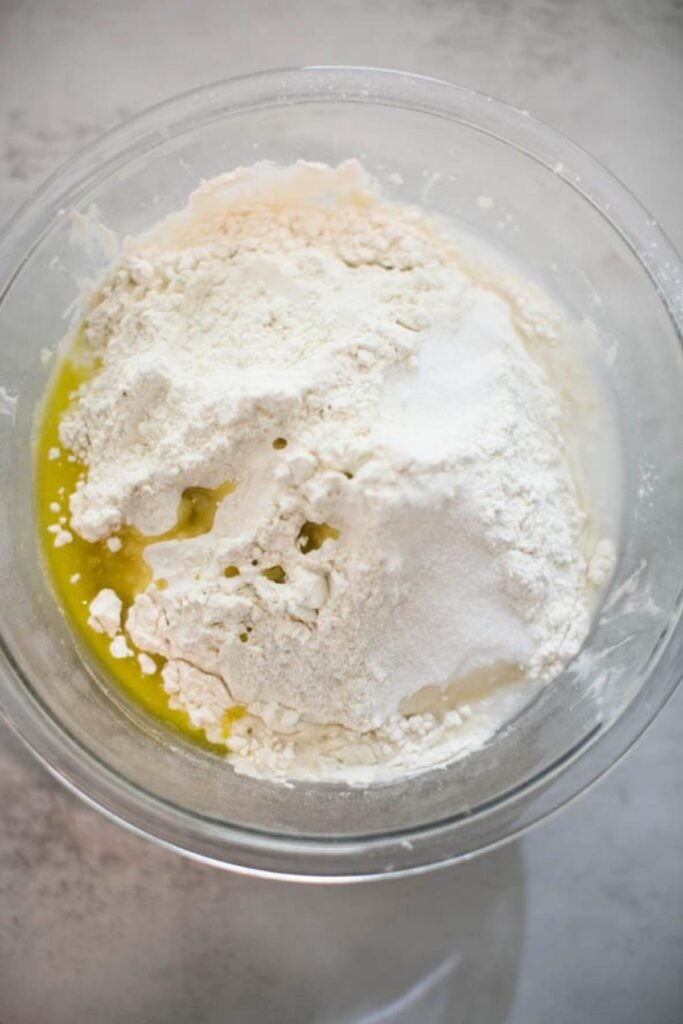
Step 2: Add the bread flour, flour, sugar, and salt. Mix all ingredients until the dough forms a loose, shaggy ball. You can use a spatula or wet hands. Let the dough sit for one hour to rest.
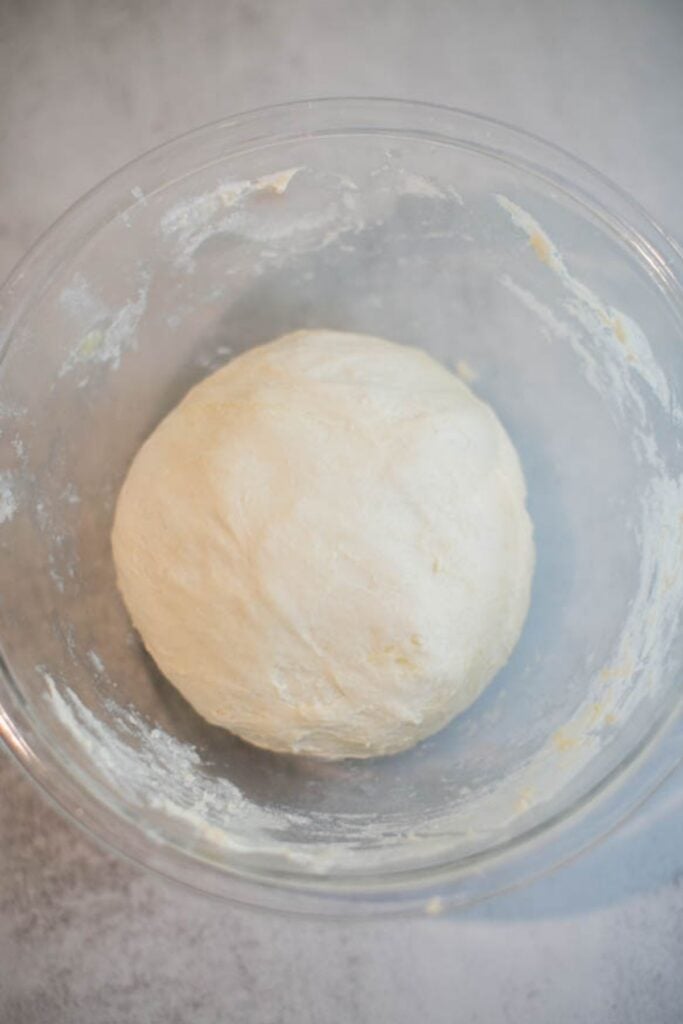
Step 3: Shape the dough into a ball by either rolling it, or stretching and folding it into the shape of a ball. Let the dough bulk ferment for 8 to 10 hours or until doubled in size (remember, this is dependent on temperature- see notes).
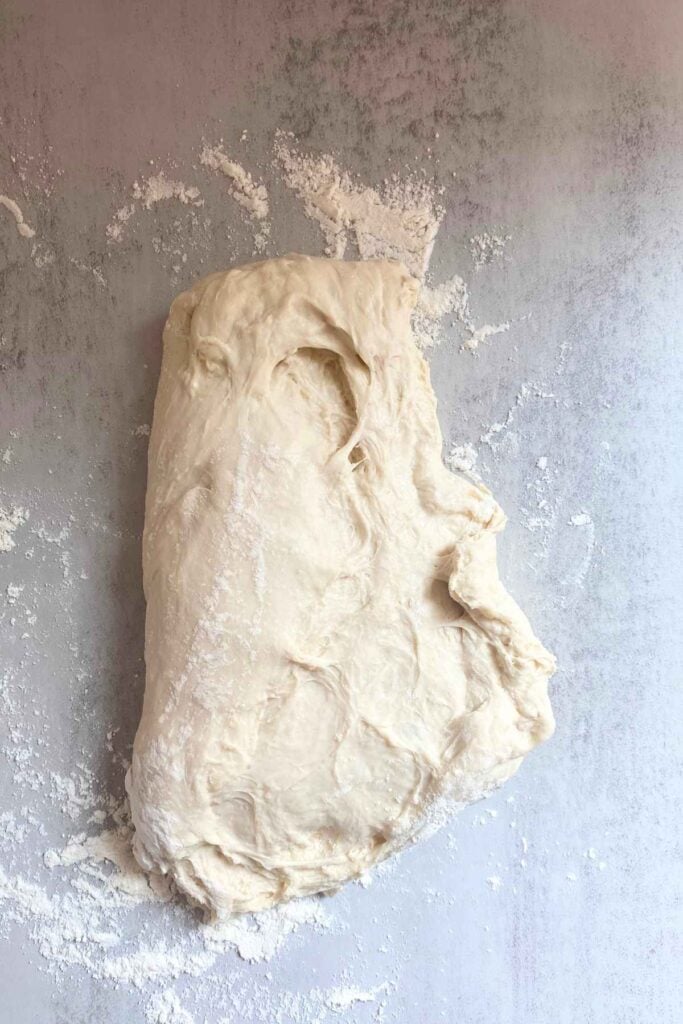
Step 4: Lightly flour your work surface, then turn the dough out. Shape into a loose rectangle shape (this does not have to be perfect!).
Save This Recipe!
Summarize and Save This Recipe Content On:
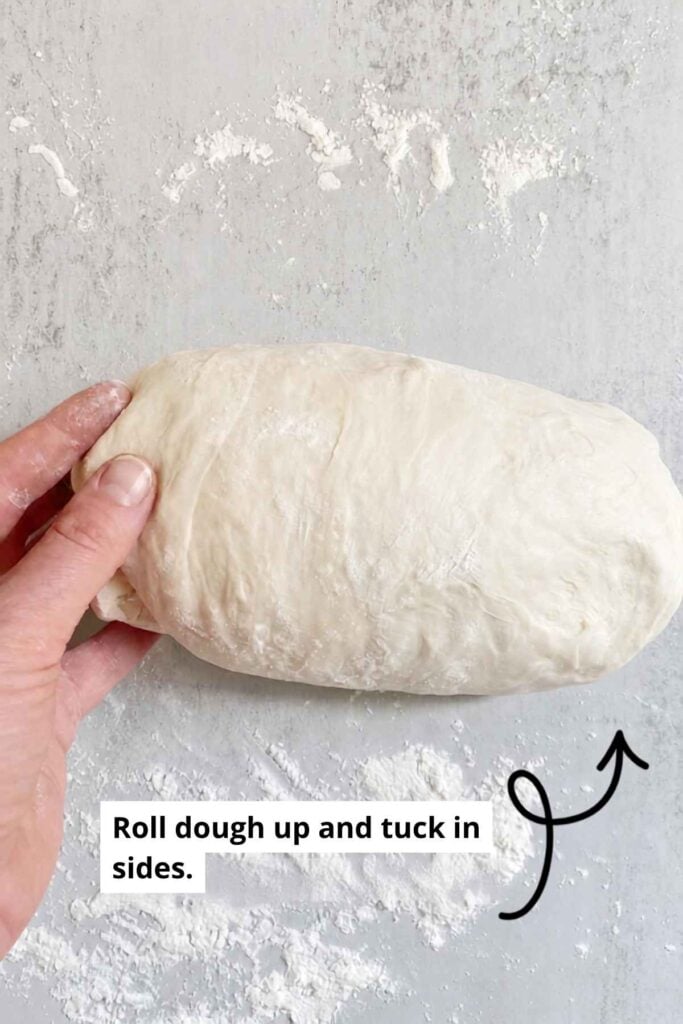
Step 5: To shape the dough into a sandwich loaf, gently roll it into a log, then tuck the ends together.
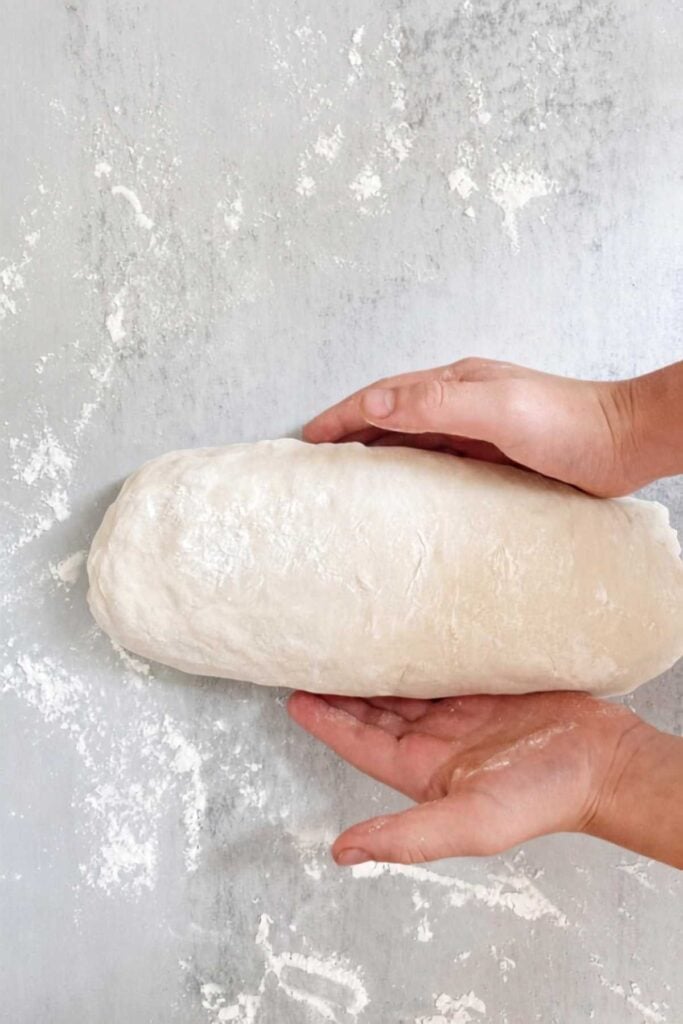
Step 6: Flip the dough seem side down and gently push on the sides of the dough to shape into a log. Let the dough rest for 15 minutes.
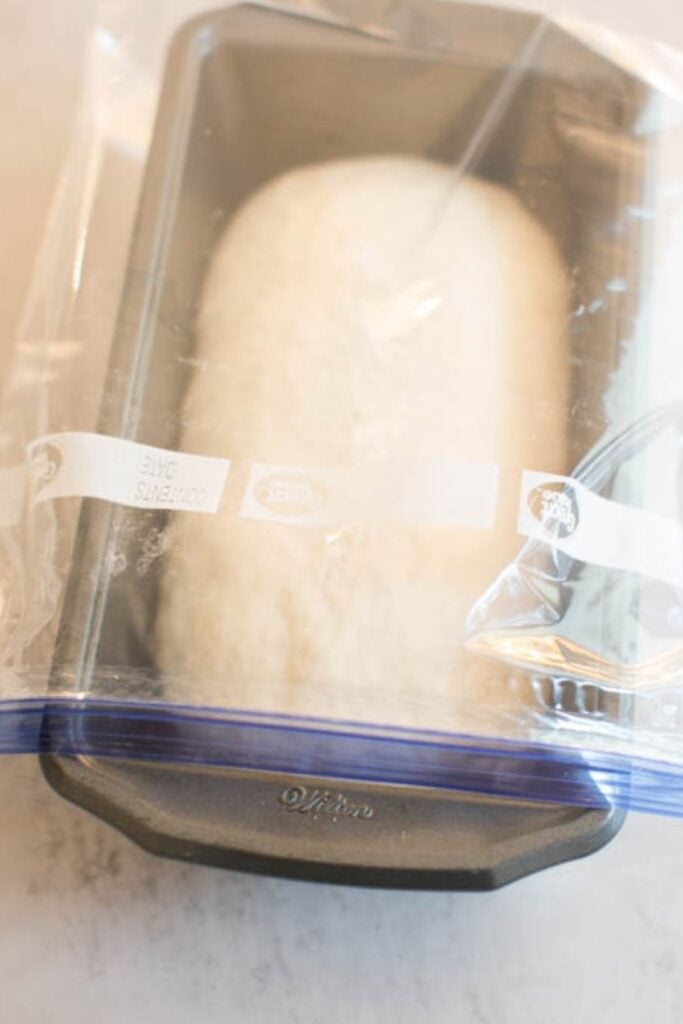
Step 7: Apply a light coat of olive oil or cooking oil to a 9×5-inch loaf pan. Place the dough into the pan and cover it with an open Ziploc bag. Let the dough rise until it is 1/2 inch above the rim of the pan.
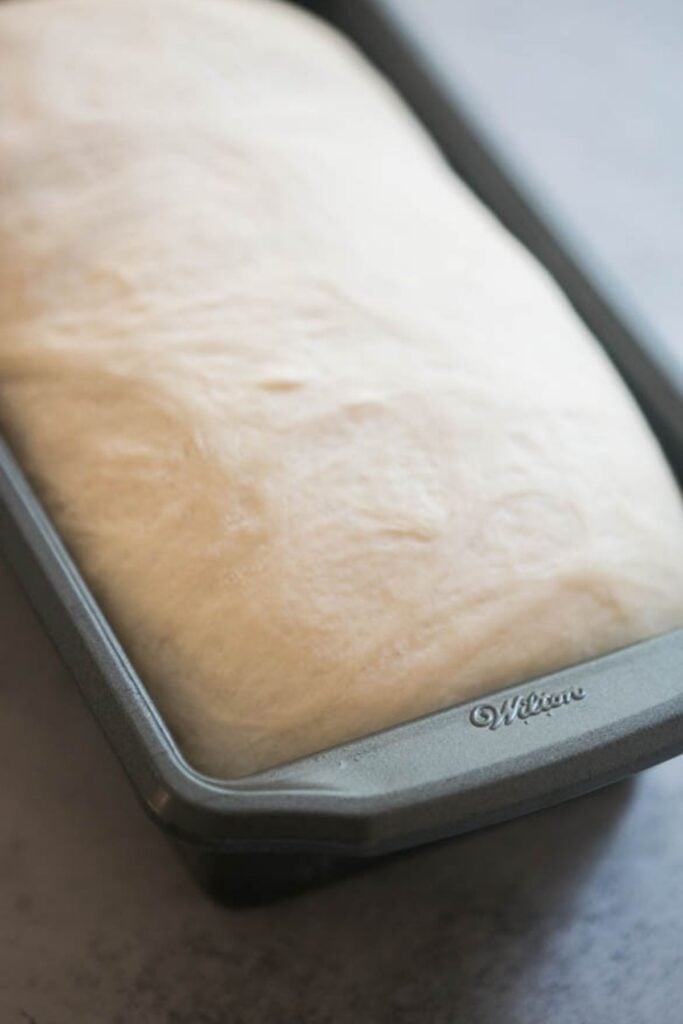
Step 8: Once the dough is puffy and has risen above the rim of the pan you can bake it. Place baking rack in center of the oven and preheat the oven to 400 degrees.
Bake for 40 minutes or until the top of the loaf is golden brown and the bread has a nice, high rise.
Let the bread cool in the pan for 5 minutes before transferring to a wire rack to finish cooling. Slice and enjoy!

Timeline
This is a sample overnight timeline based on a room temperature of 71-73 degrees F. This recipe can be adapted to a same day timeline if it fits into your schedule better- reference my guide to easy sourdough baking schedules.
- 9 pm: Mix dough
- 10 pm: Shape dough into ball + bulk rise overnight
- 7 am: Shape dough into loaf + 2nd ferment in loaf pan
- 10 am: Bake
Storage
Store uneaten portion of bread in a zip-loc bag, closed paper bag, or airtight container for 5-7 days.
To freeze, double wrap the bread in aluminum foil and then in a freezer-safe bag and freeze for up to three months.
Easy Sourdough Sandwich Bread Faq’s
No, you do not need to score sourdough sandwich bread.
The right mixture of bread flour, all purpose flour, sugar and oil, as well as letting the dough ferment in a warm spot encourages this bread to be light, fluffy, and delicious!
Sourdough sandwich bread is a softer bread then than traditional sourdough boules. Ingredients like honey and oil give sourdough sandwich bread a softer crust, while recipes for round sourdough loaves feature just water, salt, flour and sourdough starter. The crust of a sourdough boule is crusty and hard.
More Beginner Sourdough Recipes
- sourdough bagel recipe
- sourdough focaccia
- whole wheat sourdough sandwich bread
- browned butter sourdough cookies
If you tried this popular Sourdough Sandwich Bread recipe or any other recipe on my blog please leave a star rating and let me know how it went in the comments below. Thanks for visiting! 🙂

Easy Sourdough Sandwich Bread (Super Soft)
Equipment
- 1 Large Bowl
- 1 Bread Pan 8.5×4 or 9×5 (see notes)
- 1 Spatula
Ingredients
- 65 grams active sourdough starter active + bubbly
- 300 grams lukewarm water
- 12 grams salt 2 teaspoons
- 14 grams sugar
- 15 grams oil (avocado or olive) 1 tablespoon, plus more for coating the pan
- 400 grams bread flour
- 100 grams all purpose flour
Instructions
- Feed Starter: Feed your sourdough starter 4-8 hours prior to making this bread, so that the starter is active and bubbly when you start the dough.
Making The Dough + First Rise
- Whisk together the lukewarm water and sourdough starter. Add in the bread flour, all purpose flour, oil, sugar and salt. Mix all ingredients with a spatula or with slightly damp hands until all of the dry flour is incorporated. Cover with a damp tea towel or saran wrap and let the dough rest for one hour.65 grams active sourdough starter, 300 grams lukewarm water, 12 grams salt, 14 grams sugar, 15 grams oil (avocado or olive), 400 grams bread flour, 100 grams all purpose flour
- Shape the dough into a ball, then cover. Allow the dough to rise until double in size. This can take 8-10 hours, but may be slightly longer or shorter depending on the temperature of your home. Go by the size of the dough, not the clock.
Shaping
- Slide the dough out onto a lightly floured work surface and stretch into a rough rectangle shape that is no longer than the length of your bread pan. To shape the dough into a sandwich loaf, gently roll it into a log, then tuck the ends in.
- Lightly oil a 9×5 bread pan and set aside. Gently push the sides of the dough in, tightening the dough and reinforcing the shape of the rectangle.
- Set the dough into the bread pan and cover. I like to cover the dough with a ziploc bag open on one end, but you can use saran wrap or a damp tea towel as well.
Second Rise
- Second Rise: Let the dough rise until it rises 1/4-1/2 inch above the rim of the baking pan. This can take 3-6 hours, depending on the temperature.
Bake
- When the dough has risen, preheat the oven to 400 degrees. Bake the dough, uncovered, for 40 minutes or until the top of the bread is golden brown and the bread has a nice, high rise. Allow the bread to cool in the pan for 5 minutes, then transfer it to a cookie rack to finish cooling. Enjoy!
Video
Notes
- For a taller loaf, use an 8.5×4 ” loaf pan. If you have a 9×5 pan that works fine as well!
- No special shaping is required for this recipe- if you feel stuck, just roll the dough into a “log shape” that fits into your pan. That’s it!
- This recipe is temperature-dependent. In warmer temperatures, the bread will proof more quickly.
- To speed up the second ferment, set the bread pan in a warm spot or on top of a food warming mat.
- The second ferment can take up to 3-6 depending on the temperature of your home. Make sure the dough rises above the rim of the pan.
- Sugar may be substituted for honey, and you may use other types of oil as needed.

I followed the recipe pretty exactly, but mine did not rise as it should have. I let it bulk ferment for ~10.5 hours, then it did not rise above the pan for the last rise (but it did rise considerably). I went ahead and baked anyways, since I had been trying to let it rise (in the oven, with the bread proofing setting) for 10 hours, and it did not have any oven spring and turned out a bit rubbery. This is my first attempt at sourdough bread, so I’m anxious to try again, maybe checking on my dough sooner during the bulk rise!
Hi Miranda! Do you know how old your sourdough starter is? I always think back to my first loaves and they had considerably slower rise (and less spring) than my loaves with an established starter. If your starter is not very old you might try a sourdough boule loaf (like this one: https://gingerhomemaking.com/easy-sourdough-bread-recipe/)
Also, my second rise is not necessarily above the pan either, but it meets the rim.
They seem to be more forgiving! Let me know what you do next and if I can help in any way! 🙂 -Jamie
Hello again! I read your response after I started my second attempt (it tasted so good the first time that I didn’t wait very long)! I did figure out that I was mistakenly using pastry flour instead of bread flour… Using the right type of flour DEFINITELY helped lol. This time I bulk fermented for about a day and a half (I placed it in the fridge as I slept, then let it warm back up again). Then I got impatient and popped it in the oven after 4 hours of rising in the bread pan (it still wasn’t quite as high as it should have been). I suppose you’re right, that my starter is still maturing and taking a long time to ferment, but I am encouraged that the dough seemed much more bread-like and had a crazy oven spring (the top completely separated from the rest of the loaf in one spot!). I’m excited to keep trying!
Hi Miranda! I am so glad you are enjoying the bread and the baking! Sourdough really is a constant experiment, we are all growing and learning as we bake. thank you for sharing your updates! And, like I mentioned before my bread does not always rise to the very top of the pan in this recipe, but the spring is usually great. Whenever something takes a long time to ferment I think well this is going to be very easy for the kids to digest, ha! keep me posted on the new things you learn and try! 🙂 happy baking- Jamie
Hello,! I was silly and started this at 12am it is now resting for one hour. Can i toss this in the fridge overnight or should I wait til it’s done “resting” and form into a ball to bulk ferment? Excited to try this! My normal sourdough loaves never turn out but I’m also fairly new to the game.
Hi Madison! Sorry I’m just now getting to this. I probably would have just let it start bulk fermenting, you can always put it in the fridge later on! 🙂
This bread turned out perfect my second time around! The first time I tried to attempt the first rise overnight in the fridge and just couldn’t get the bread to turn around for me from there. After following the instructions correctly the second time around – absolute perfection! My new go-to sandwich bread!
Hi Nikki! I’m so glad it worked for you and you are enjoying the bread. Thank you for the review! I have noticed with sandwich breads that they can have a hard time recovering frmo the fridge, I’m not exactly sure why that is, but I had the same issue recently with my whole wheat loaf.
How does this bread freeze? When it’s thawed do you put it back in the oven for a few minutes?
Hi Chevie, yes you can freeze, thaw at room temperature, and then put it in the oven at a lower temperature to warm it up. You could also slice it prior to freezing and then toast the slices individually when ready to use.
Thank you so much for sharing. I’ve tried other recipes without much success. Tired yours and it’s the best I have done. I now only use this recipe to make my bread. Thank you❤️
You’re welcome Aneglika. I’m so glad you are enjoying the recipe. Thank you for sharing, it made my day to read your comment!
So I owe you again lol. Today I added cheddar cheese and jalapeno to your recipe and it turned out great. I wish I could add a picture. Thank you so much.
Thats so exciting Angelika! That sounds so delicious, I’ll have to try it when I get home. You can send me photos to my fb business profile Gingerhomemaking. I don’t post there a lot but do check it. Thank you so much for sharing, when we get home from vacation I will try this.
Help!!! Our oven just went out. Is it possible to bake in an air fryer? That’s the only option I have available at the moment.
Hello! Ugh I’m so sorry to hear that! I do not have an air fryer but from doing a quick search on the internet it looks like you may be able to? Also, you can put the loaf back in your fridge until you can fix your oven or make it to a friend’s house to bake if need be! let me know if you try the air fryer and it works, I’m curious!
Air Fryer worked out great. I cooked at 320 degrees for 25 minutes. After 13 minutes I removed from the baking pan and let finish cooking “naked” in the air fryer for the remaining 12 minutes. Had an internal temperature of 192 degrees.
how cool Robert! That is so good to know. I will try this out as soon as we get an air fryer. Thank you for sharing your process with everyone!
Do you score this loaf?
You do not have to score it!
My bread is turning out great and tastes perfect but my loaf always explodes on the top on just one side and ends up not even or smooth on the top, any suggestions?
Hi Lauren! Do you know how long you are fermenting it for? I have had this happen when my bread over ferments (I just did this yesterday, actually!). You could try cutting back the ferment time just a little to start. Alternatively (and cofusingly, I admit), this can also happen if the bread is UNDER fermented. I know for sure I over fermented my loaf the other day. You could start here and experiment with bulk ferment times. Let me know if anything changes!
I made your bread today. I have never weighed my ingredients before so I thought I’d try it. It came out beautifully! I can’t wait for it to cool off! Thank you for your excellent instructions and illustrations
Hi Kim, Thank you for your sweet comment. You made my day! I’m glad the recipe was easy for you. Weighing ingredients can be a game changer with sourdough. I hope the bread was delicious!
Would it be possible to make this an inclusion loaf? Just made this bread tonight and it’s AMAZING
Hi Brittany! Thank you so much for letting me know you love it! Yes, I am working on a few versions of it that will be published over the next month or so… You could also try adding in your own inclusions as well… just keep in mind that heavy inclusions can affect rise time. Keep me posted if you try any! 🙂
Would I be able to refrigerate over night after putting in the loaf pan? It will be way too late to bake tonight I think and would rather in the morning
Hi Lexie! Yes, you definitely can do that. 🙂
If I put it in the refrigerator and bake it the next day do I let it sit out and come to room temperature or just put it in the oven?
Hi Sonjia, if has gone through both ferments you can bake it cold from the oven. If it hasn’t had the second ferment you will want to make sure and let it come to room temperature and puff up in size before baking.
Hi, is the sugar necessary? I would prefer to have no added sugars in my diet.
You can substitute one tablespoon honey or even leave it out!
Your loaf pan looks like a 9×5 inch like mine… is the “9×15 inch” a typo?
Yes, it’s a 9×5 pan. This is a typo — I have corrected it a few times and for some reason wordpress does not process the change! :S Thank you for letting me know!
So it does not take the full 40 minutes correct? The top of my bread was golden in 15 minutes @400F
Hi Joy!
Oven temperatures can vary, but after 15 minutes the inside would be done. If the top of the bread is browning too quickly, I would move it to a lower rack in the oven. 🙂
Hello!
Excited to make this but wondering if I have to use bread flour or can I use all purpose or whole wheat flour?
I have so many kinds of flour, would love to not add another to the limited pantry space!
Thank you!
Hi Brittany! I would not use whole wheat flour as a straight substitute but you most certainly can use all purpose flour and it should turn out just fine. 🙂
Tastes amazing but when I did the second rise in the loaf pan, it barely rose to the top of the pan and I left it for 4 hours in the oven with the light on because my house is cold. Any tips?
Hey Brittany! I have had this happen a few times too. The only thing I can think is that it may be due to when the sourdough starter is used. Also, adding a bit more sourdough starter could help it rise faster. I’ll experiment this week and let you know what I come up with. 🙂
Buy an inexpensive seeding mat from Amazon and be patient 😊 I waited almost 8 hours one time to get my sourdough cinnamon rolls risen enough (the key to the flakiness).
great idea Jody thank you! 🙂
I found that my house is too cold at times, and I have had success using an electric heating pad on medium/high heat to help it rise a bit faster/more. I basically just wrapped my loaf pan in the heating pad until it was close to the top, then move the heating pad away from the top of the pan so it could rise more. I still left it in the zip lock bag as well to help it keep more of the heat and moisture in.
That is a great tip thank you!
I have tried lots of sourdough bread recipes and this one is the best and comes out great every time! My whole family loves this recipe. Thank you!
thank you so much for letting me know Krista! I hope you continue to enjoy the recipe. 🙂
Have you ever refrigerated your dough for the first rise? Also, any suggestions for doubling the recipe for two loaves?
Hi Maxine! I have refrigerated the dough when life has interrupted the process, but not specifically for the first rise. I would plan for additional time if you try it. As for doubling, yes you should be able to double all the ingredients (including the starter) and divide the dough when you bake. 🙂
Looking forward to making this bread. What kind of oil? Assuming vegetable but just wanted to double check.
Great question Mackenzie! I typically use olive oil or avocado oil. You can use other oils like canola if you prefer. 🙂 Let me know how it turns out!
The recipe card says to bake at 400 degrees, but the blog post says 350 degrees. Do you preheat to 400 then drop to 350 or which temp do you use?
400 degrees is correct. Thank you!
Is it really a 9×15 pan, or is it 9×5? It looks like a 9×5.
Yes, 9×5. Thank you!
Hi, the recipe doesn’t mention sourdough discard but the instructions do. Do I need to add discard in addition to the active starter? How much discard? What is the purpose of adding both active starter and discard?
Hi Kayla! Yes, I found the error—the instructions should have said active sourdough instead of sourdough discard. I apologize, there is no discard in this recipe. Thank you so much for bringing that to my attention!